
The journey begins long before we ingest the medicine, and continues long after we leave the ceremony space. When we hear the phrase ‘psychedelic integration’, we may imagine something relatively tangible, maybe even simple – reflecting on the experience, journaling about it, or talking about what happened during the journey.
True integration goes much deeper than that.
This is what psychedelic integration actually is – not just reflection, but lived, ongoing transformation.
Integration is the slow and unknown process of weaving the experience of the ceremony into the fabric of daily life. It is where the journey – sometimes subtle, sometimes earth-shattering – translates into our lives: how we live, how we relate, and how we show up in the world.
The insights, emotions, and realizations do not complete themselves in the ceremony space. What happens there is the beginning. The seeds are planted there. The real shifts and transformation happen in everyday life, when we show up for it all. It is a continuous unfolding.
Ceremony may open the door. Integration is the path we walk once we step through it.
The medicine journey begins the moment we sign up for the ceremony. In that moment, we enter into relationship – a connection – with the medicine. It is as if it hears us, sees us, feels us. A meeting is already taking place. In a sense, the moment we sign up is also a contract we sign with our higher Self, with consciousness, with something larger than us.
If we pay attention, if we open ourselves, slow down, and take time in our lives to connect with and honor the medicine before we sit with it, we have the opportunity to be with it, feel it, get to know it, and begin to work with it.
The Spaces in Between
The medicine of the medicine is not, and never was, only in the peak experience – in the fire, in the wild visions, or in the revelatory moments of being held by and shown through the ceremony.
The medicine, the message, the teachings – the actual teachings – are in the spaces in between. They are in the seemingly mundane moments, when the wild journey lands, when our system and our body settle, when we land, pause, and stop. When we stop grasping for the meaning of the moment.
This is where integration lives.
Based on my lived experience, and as a psychedelic integration coach, I see this again and again – the ceremony opens something, but life is where it is lived.
The real work is not a performance
Sitting on that mat in the jungle, or in the circle however it looks, being whisked away by the medicine, by other realms, by something beyond us – that is part of the journey, clearly. Without it, there would be no peak experience to integrate.
But the actual medicine is in the surrounding moments, in life – the preparation we do beforehand, our commitment to the upcoming journey, our honoring and respecting and connecting with the medicine – and in the integration: how we hold the journey, how we allow it to land, how we stay open and trust in the medicine, how we stay present with the unfolding and unraveling of it all.
It is certainly more glorious, and feels more adventurous and impactful, to go into ceremony – to drink the medicine, to sit on that mat or in that circle, to be whisked away, carried by, held by, guided by – something outside of us.
With the fervor of entheogens and psychedelics entering our world, there is a lot of hype. In our classical Western cultural way, these medicines are often approached as something that is here to fix us, to do the work for us. As if we just show up with our pain and our wounds, and it will take care of us. As if this will fix us like a magic pill.
That is not how it works.
The medicines work with us – not for us.
We show up. We invest ourselves – our energy, not just our money – and we co-create a journey.
Something alive.
Something relational.
Something that touches all and everything.
Together, we co-create a motion, an energy, a dance.
Not danced for.
A co-dancing.
Expectations, surrender, and the fantasy of “the magical pill”
We commonly go to ceremony, or embark on psychedelic journeys, with an agenda.
We may tell ourselves and the world that we only have intentions and no expectations. That we are free from expectation. That we surrender and allow the journey to be exactly what it needs to be.
And ultimately, this is the way.
It is also important to check in with ourselves honestly about the expectations that may still be there. To notice them. To hold ourselves gently in our inability to fully let them go. Expectations are deeply ingrained in us, and hard to release. To some degree, we are hardwired for them.
When we are new to this work, we commonly have the idea – and often the frantic hope – that this one journey, this one ceremony, this one medicine, this one time, will be the one. The one that changes my life. Unlocks the final lock. Lands the final piece in the puzzle. That after this weekend, this trip, this ceremony, I will be healed and the journey will be complete.
I am here to say: this is not how it works.
I know this from fifteen years of deeply walking the entheogenic path, and from life at large.
This is not limited to psychedelic integration. This is life.
I return again and again to the same knowing:
The real medicine is in the spaces in between. In everyday life. In the unfolding and the unfurling. Not in the peak experience.
I had a client who, a month after his Iboga ceremony, told me that something had really shifted. He was trying to figure out whether it was the Iboga ceremony, or the many Ayahuasca ceremonies and other work he had done before that.
This is how we are wired. We think we need to know. We want to understand. We want to grasp with the mind exactly what caused the shift.
I said to him – and I say this often – it does not matter. You are where you are today. Perhaps because of the Iboga ceremony. Perhaps because of all the Ayahuasca ceremonies. Perhaps because of none of the above. Perhaps you simply arrived here today.
What matters is that something has shifted.
And also: there is no final arrival.
My own experience after Peru in 2012
One of the most profound moments on my medicine path came after I returned home from six months in the jungle in Peru, deeply immersed in Ayahuasca. During that time, my life vastly, profoundly, inexplicably, and forever changed. I was blown apart – Ayahuasca took me apart into a trillion pieces and put me back together again. From the outside, I looked the same. And on the contrary, I was a new being – one I did not yet know how to be.
Everything was the same and nothing was the same.
I came home to Whistler, thinking life was going to be easy and great from there on. Little did I know that I was just about to embark on one of the most challenging times of my life. Nothing in the world made sense. My entire life, and the world as I had known it, seemed utterly strange and dysfunctional. All I could feel everywhere was disconnect and disharmony.
At that time, there was no such thing as integration. Centers and facilitators were pumping people in and out of ceremonies with a kind of “hope you enjoyed, and good luck with the ride from here on” approach.
I came back from Peru with grand expectations of the “new me” and my uplifted, inspired, heightened life from there on. I also had big plans to return to the same place in Peru soon, to keep sitting in ceremony.
Reality had it otherwise.
It was hard to fit into the work world, which left me with very little money. I could not afford to go back to the jungle. A summer passed, then a winter, then another season. I felt frustrated that I could not afford to continue my path with the medicine in the way I thought I needed to.
And then, at some point, as time passed and I still had not returned to Peru, I had a major AHA moment – a deep realization, a message, a download.
In that moment I understood with full clarity:
THIS IS THE MEDICINE.
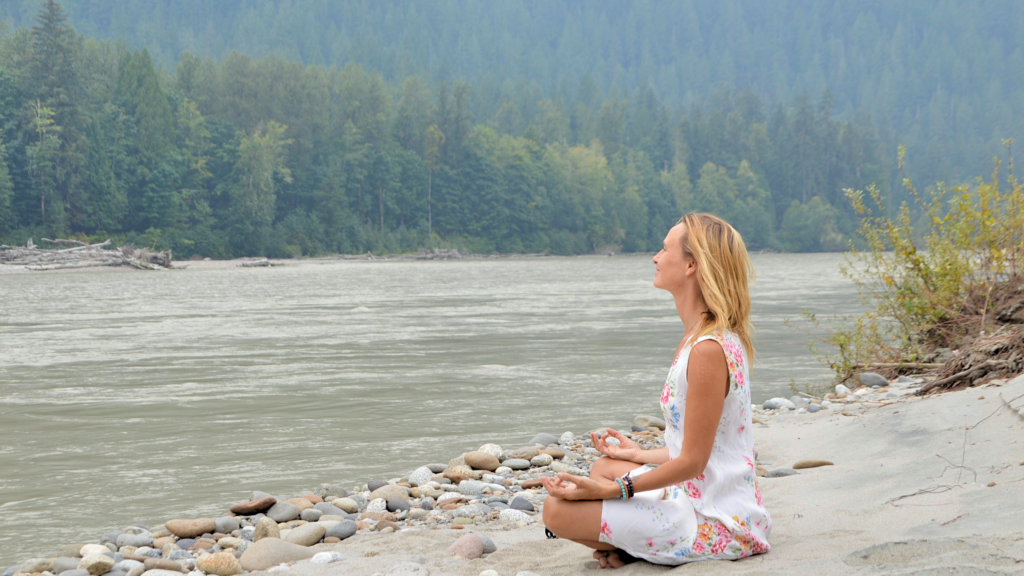
For me, it was sitting on my meditation pillow, in aloneness, showing up day after day. Sitting by the Stawamus River under “my” tree through rain and shine.
Sitting in stillness.
Sitting in the uncomfortable, in the stickiness.
Sitting with it all, being present with it, embracing the not going anywhere and the no doing. Being present and holding it all.
And – it does not have to look like this. This was my path. My doorway.
The medicine is not limited to the meditation cushion.
It is in living life in all its ordinary ways – walking the dog, doing the dishes, caring for children, showing up at work, moving through the day.
It is in showing up, again and again, day after day, breath after breath.
Sometimes in the company of others. Sometimes in aloneness.
This is where it all happens.
The medicine – the real shifts, the real transformation – happens in the seemingly non-happening, in-between moments. Not in the glorious peak experience. Not in the wild magnificence, the horror, or the majesty of the ceremony moments. Not only in those times when the medicine and the shaman or the facilitator hold us, when something outside of us is working for and with us.
It is in the here and now. It is in all the moments where I hold myself, where I show up, where I sit with what is.
Where I am the steward. The captain. The everything and everyone.
This was one of the deepest teachings of my path.
What is integration, really?
In my words, integration is taking a peak experience and weaving it into our everyday life, our existence, into the core essence of who we are.
Integration is more than journaling and meditating on our experience. Integrating a life-changing psychedelic experience does not have a solid framework. It can be hard to put a finger on what it really is. Much like the medicine journey itself, the ceremony is often impossible to fully put into words or frames – integration is very much the same.
And still, there are ways we can support it.
Integration asks us to stay present with the process. To stay curious. To allow it to be what it is – as it is. To stop trying to force meaning too quickly. To trust the process. To breathe. To keep showing up, again and again, for what arises and what is present.
It asks us to stay with the process in the midst of agony, discomfort, and resistance. To become aware of how we deal with resistance. To remember that much of what shows up is the medicine – even when it is not clear in the moment.
Sometimes integration looks like sitting in silence. Sometimes it looks like journaling. Sometimes it looks like dancing. Sometimes it looks like not knowing. Sometimes it looks like crying in the airport after missing a flight and realizing that this, too, is part of the journey.
There is a sense in integration of breathing out, letting go, landing, embracing – of just being with it.
Practical support for integration
It is deeply helpful to have support – a coach, a witness, a trusted guide, a community, or simply someone who understands the path and can hold a container. This does not always mean talking everything through. Sometimes the greatest support is simply being witnessed without having to explain the whole experience. It is also important to understand that speaking too quickly, or too much, about a journey can sometimes pull us away from what is actually happening. The experience can become the story, and the story can begin to distort the heart of the experience itself. There is much gold in holding the experience quietly.
Journaling is also supportive. It does not need to be pretty, perfect, or correct. It can be messy, fragmented, incomplete. It can be one sentence. It can be many pages. Sometimes, no words come. And that is okay too. But making space for the words to come can be a valuable part of the process.
Taking care of the physical body matters. The ceremony clears and resets the system, and what we do afterward matters. How we eat, rest, move, and live can either support the pathways that have opened or close them down too quickly.
Moving the body. To integrate the experience somatically into the physical body, our physical being, we need to move. This can be through dancing, walking in nature, qigong, yoga… When we move, the experience lands, integrates, and the body opens up to holding us.
This extends beyond the physical body – it includes the mind and the spirit. Being mindful of what we take in, not only through food but through our senses. The media we consume, the conversations we engage in, the environments we place ourselves in. Noise, news, violence, overstimulation – all of it lands somewhere in our system. Integration is, in part, about becoming aware of what we are allowing in, and choosing, as best we can, what supports clarity, steadiness, and connection.
Nature matters. Spending time in nature and with the elements is profoundly important, always, and especially in integration. The medicines connect us with something larger than ourselves. They open up the connection to nature and all living things. Spending time simply noticing the natural world that we are part of is key.
And an ongoing relationship with stillness matters. Just being still with what is, noticing what is alive and present in the moment. The journey does not end when the ceremony is over. In many ways, this is the beginning. Creating time and space to sit, be present, connect, and continue listening is one way we keep honoring the medicine and allowing it to work in and through our lives. This can be through meditation, or simply pausing for brief moments throughout the day.
Integration is life
Integration is not limited to psychedelics.
Life is an ongoing integration.
We may be integrating a profound meditation, a falling in love, a breakup, a retreat, a festival, a loss, a revelation, or a meaningful moment of any kind.
Life is constantly asking us to meet what is here, now – to receive it, to be with it, to let it live through us.
The journey unfolds. Sometimes dramatically. Sometimes quietly. Sometimes through beauty. Sometimes through discomfort. Sometimes through clarity. Sometimes through utter not-knowing.
Ceremony may open the door.
But integration is the path we walk – in our kitchens, in our relationships, in our aloneness, in our stillness, in our messiness, in our devotion – in the magic and the mystery of our ordinary lives.